
Don’t forget to send SB SM your list of “Best Feelings in the World” by next Monday for Tuesday publication
[Where’s Banksy when we need him? Or her. Or them. Personally, I think it was masterful how a few individuals pulled the collective leg of the rest of the world by perpetrating such a low-tech hoax. I find it equally amazing that the creators could create such complex designs, so quickly using the most basic tools. Those human beings can be pretty damn clever when they put their minds to it. SB SM]

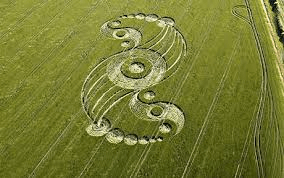
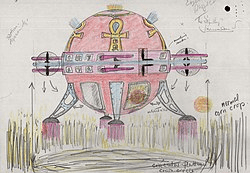
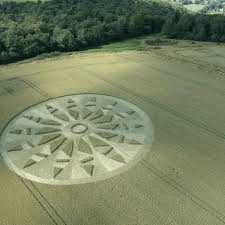
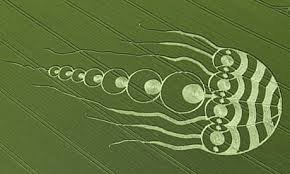
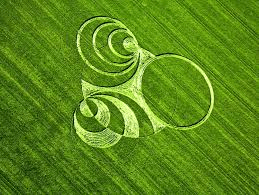
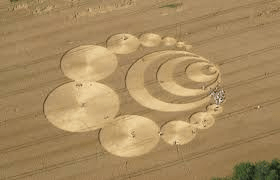


At the height of the crop circle craze of the 1980s and 1990s, any number of explanations, natural and unnatural, were proposed for the perfectly crushed patches of cereal appearing across the English countryside and beyond. Were they left behind by alien visitors, flattened by freak weather events, or manipulated by the Earth’s magnetic fields? Cereologists, dedicated crop circle researchers, looked to the archives to turn up whatever historical record existed. In 1989, editors of the British paranormal magazine Fortean Times surfaced a pamphlet that appears to be the oldest known image of a crop circle. Dating to August 22, 1678, The Mowing-Devil: Or, Strange News out of Hartford-shire opens with an impish woodcut. The small, plump figure of the devil stoops, scythe in hand. He is midway through a field of blazing oats, making his way inward in concentric rings, leaving a trail of felled stalks in his wake. His mouth is open as if to catch his breath as he works, his small goat tail wagging.
The pamphlet, just five pages long, recounts a labor dispute ending with an unwitting deal with the devil. A wealthy farmer, his crop of oats ready to be harvested, approaches his poor neighbor to mow them. The mower negotiates in earnest, setting an honest price (albeit a bit higher than usual) for “the sweat of his brows and marrow of his bones”. Frustrated with the ask, the farmer counters with a price below the market rate. Even when the mower lowers his quote out of a desire to serve, the rich farmer remains unsatisfied: he tells his neighbor “that the devil himself should mow his oats” before he has anything further to do with the “sorrowful Yeoman”.
This farmer, the pamphlet opines, has forgotten about the Christian duty of the wealthy to meet the needs of his neighbors. Judgement comes in the form of strange “preternatural events”. That very night, the oat field is reported ablaze. The next morning, the farmer finds his crop not burned, but unnaturally felled “as if the Devil had a mind to shew his dexterity in the art of Husbandry . . . he cut them in round Circles, and plac’t every straw with that exactness” — more perfect than any man could have achieved. The mowing is so supernaturally skilled that the oat farmer “is as yet afraid to remove them”, and the devil becomes an unlikely instrument of retributive peasant justice: the crop circle is as much an example of the supernatural as it is of Christian virtuosity. The truly “evil” phenomenon seems to be the way that early modern economy intrudes upon neighborly relations.
At the end of the day, the moral lesson impressed on the farmer matters far more than any concrete explanation of the crop circle itself. In fact, the crop circle is only one of many “hits of providence” that “go to the production of one Crop of Corn, such as the aptitude of soyl, the seasonableness of showers, nourishing solstices and salubreous winds”. And in that case, “we should rather welcome maturity with devout acknowledgements than prevent our gathering of it by our profuse wishes.”
Text by Thea Applebaum Licht
This miniature “crop circle” appeared in my back yard the day after the Fourth of July. When I sent the picture to my son, Patrick, he said “That’s where I set the grill cover dawn while cooking the sausages.” Damn Weber!

from Wikipedia:
Although obscure natural causes or alien origins of crop circles are suggested by fringe theorists,[4] there is no scientific evidence for such explanations, and all crop circles are consistent with human causation.[5][6][7] In 1991, two hoaxers, Doug Bower and Dave Chorley, took credit for having created over 200 crop circles throughout England,[8] in widely-reported interviews. The number of reports of crop circles increased substantially after interviews with them. In the United Kingdom, reported circles are not distributed randomly across the landscape, but appear near roads, areas of medium to dense population, and cultural heritage monuments, such as Stonehenge or Avebury.[9] They usually appear overnight.[10][11] Nearly half of all crop circles found in the UK in 2003 were located within a 15 km (9.3 mi) radius of the Avebury stone circles.[9]
Stephen, I have this recurring fantasy that we will eventually make it to Mars, and when we finally do, one of the first missions will be to visit the still-operating Lunar Rover. But when the astronauts reach it, they discover that it’s covered in graffiti—a gift from the same delinquents who perpetrate the crop circle frenzy.