
[Silverbelle Sandy and Silverback SM have been in San Miguel de Allende. While SB Sandy has been immersed in history and artistic creating, SB SM has been watching Judases explode (and drinking beer). Here’s Sandy’s account of creating her own, miniature Mojigangas. Now the challenge is getting it home. SB SM]

by Silverbelle Sandy
Mojigangas, the colorful, fifteen-foot, paper mache puppets, are staples of every San Miguel fiesta, parade, and wedding. In between special events, they are on display throughout the city.
Their origin is traced to the tradition of The Giants, “Los Gigantes,” of Spain. They were brought to San Miguel de Allende, Mexico in the 1600s.
I took a five-class Paper Mache Workshop from Guadalupe Trejo, a Mexican artist who has worked with paper mache for 34 years. The workshop was offered in Spanish with an English translator, Lupita. Classes were held on the rooftop of Guadalupe’s house where the paper mache and plaster were sun-dried in between classes.)

Guadalupe Trejo’s “Engrudo”
Mexican Paper Mache Paste
Ingredients:
1 cup wheat flour
4 cups water
Mix the cup of flour with 2 cups of cold water.
Heat the remaining 2 cups of water. When the water boils, add the cold water and flour mixture. Stir the mixture to a thick, smooth consistency. Turn off the heat and let the mixture cool.
Spread the paste on both sides of paper strips and attach them to whatever form you are creating.
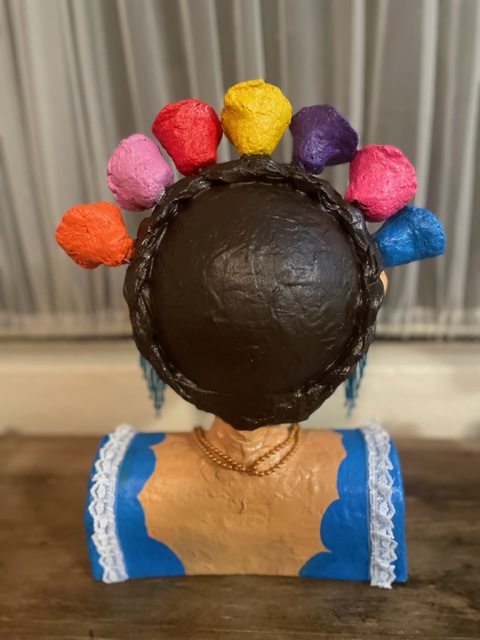
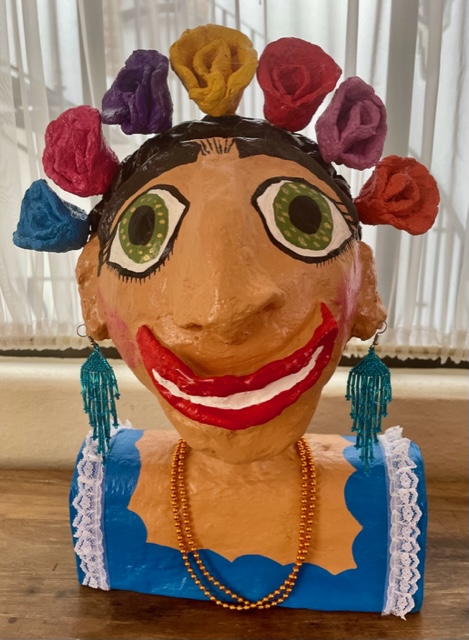
For my mojiganga, the form consisted of a balloon (face), a toilet paper roll (neck), and two pieces of cardboard bent into a U-shape (chest). The hair braid was made by covering three long strips of paper with paste before twisting them into shape. Finished dimensions of the mojiganga: 16”h x 10” w).
Guadalupe Trejo’s Paper Pulp
The paper pulp is the plaster used to mold features on a paper mache base, or to create an object, such as a bowl, tray, dish, or vase, by first rolling the pulp flat.
Ingredients:
1 roll of two-ply toilet paper
1 cup of Engrudo
½ cup of powdered plaster
Separate and tear the toilet paper’s two-plies. Add them to 1 cup of Engrudo until the mixture reaches a pizza dough consistency. Gradually knead the dough and add the plaster until you get the desired consistency to roll or mold. You have one hour to work with the plaster before it hardens.
(The paper pulp was used to mold the eyebrows, nose, ears, and mouth of my mojiganga. It was rolled into flat discs then shaped to create the flowers. The molded facial features were sanded to refine their shape before paint was applied.)


And … (drum roll) … here’s the final result:
Thank you for the written explanation and recipe of the laborious projects we went thru together Sandy. Now I don’t have to watch and listen to the video to do it again. Who knew all of these wonderful mojigangas we are surrounded by here in San Miguel de Allende were so much work? Truly a “labour of love” in the creative process. Fun meeting and “playing” with you.