
[The word “mongoloid” was coined by a German physician to describe children born with Downs Syndrome. It was a disparaging, racist reference to the Mongol people who, under the leadership of Genghis Khan merely established the greatest empire in the history of mankind. It’s a great example of how history is re-written for all the wrong reasons. The same has happened systematically with the Neanderthals. SB SM]
Since the 1800s, Neanderthal depictions have evolved not only with changing science but also due to social views. An archaeologist explains why visualizations of our evolutionary cousins matter.

A photographer in 2004 snaps pictures of a pensive Neanderthal figure on display at the Prehistoric Museum in Halle, Germany.
Sebastian Willnow/DDP/AFP/Getty Images
21 FEB 2024
NEANDERTHALS’ FIRST PORTRAITS
In 1888, a few decades after the first scientifically named Homo neanderthalensis fossil surfaced, anthropologist and anatomist Hermann Schaaffhausen made a portrait of what that Neanderthal might have looked like in life.
Found in Germany’s Neander Valley, the actual fossil was just the top of a skull—a teardrop-shaped dome fronted by big brows—without the facial bones below. But Schaafhausen filled in the blanks and sketched a Neanderthal visage in profile: a hairy, husky fellow with a protruding jaw.
Eighteen years earlier, scientist Louis Figuier published an illustration that depicted the Neander Valley individual as a biologically modern, fur-clad European. From the same fossil, two contemporaries drew diametrically opposed images.
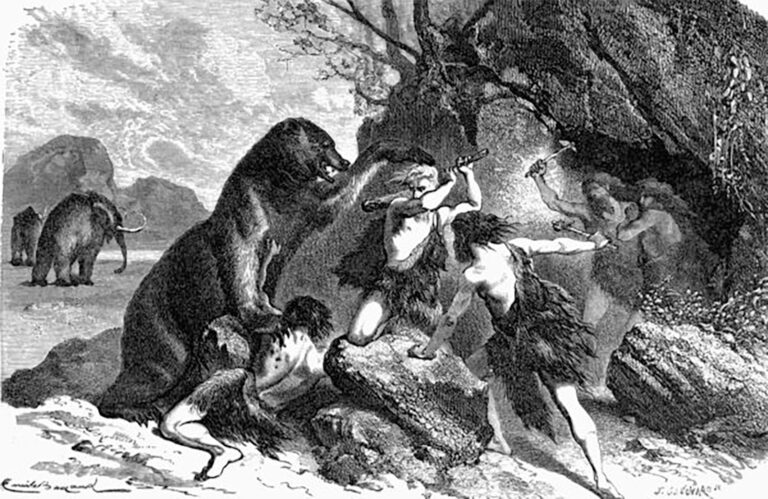
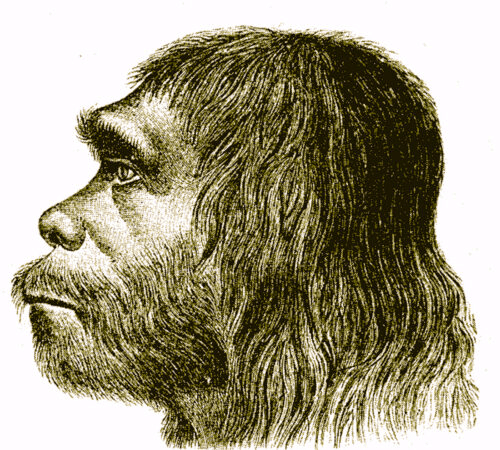
Why did this happen?
As a social Darwinist, Schaaffhasuen believed various races represented different stages in a linear progression of human evolution. To him, Neanderthals belonged to a primitive stage of cave dwellers. Gorilla-like and uncivilized, Schaaffhausen’s Neanderthal begged for physical and moral betterment. Figuier, a creationist, viewed Neanderthals as humans like us—manifested by a Biblical God on the sixth day of creation. He envisioned Neanderthals as biologically modern, but—like babies—needing to learn the ways of civilization.
Since this early set of illustrations, plenty of ink and paint has been spilled over the interpretation and depiction of Neanderthals. These images must be situated within their historical contexts. When looking at Neanderthal reconstructions—and scientific illustrations at large—it is important to unpack how social and political views color the rendering of evidence.
Interpretations sometimes say more about their makers than their subjects.
UNCANNY COUSINS
Neanderthals, our evolutionary cousins, diverged from our lineage around 600,000 years ago. They roamed Eurasia for hundreds of thousands of years until they went extinct around 40,000 years ago. In many ways, they resembled our Paleolithic ancestors: Both used stone tools, cooperated, and took care of their kind. But distinctions stand out. Stockier and endowed with massive brows, Neanderthals survived some of Eurasia’s coldest conditions where no Homo sapiens ventured during those cold spells.
What Neanderthals looked like has always mattered. More than just accompanying artwork, Neanderthal visualizations represent a touchstone for what it means to be human.
Before the 20th century, only scattered bones of Neanderthals had been discovered. The first nearly complete skeleton was found at the French site of La Chapelle-aux-Saints in 1908. The French paleoanthropologist Marcellin Boule analyzed the fossils and placed Neanderthals closer to monkeys and apes than humans. An image, based on his conclusions, showed a hairy, stooped ape-like figure holding a club and stone.
In contrast, British anatomist Arthur Keith thought that Neanderthals belonged to the European lineage. This was not a gesture of inclusivity: Keith, a proponent of scientific racism, believed that humankind originated in Europe. He worked with an artist to produce a Neanderthal illustration that, just like Figuier’s, looked like a European man. The figure sat by a fire making stone tools while wearing fur clothes and a necklace.
Boule’s ape-like man met an evolutionary dead end. Keith’s nearly European Neanderthal figured into human history.

(For the 1909 illustration “The Man of La Chapelle-aux-Saints,” artist František Kupka relied on Marcellin Boule’s scientific interpretation of Neanderthal remains found in France. Charles Phelps Cushing/ClassicStock/Getty Images)

(Using the same fossil material, curators and paleoanthropologists commissioned this bust, “The Neanderthal Man of La Chapelle-aux-Saints,” for the American Museum of Natural History in 1915. Wellcome Images/Wikimedia Commons)

Despite differing stances about Neanderthals’ place in human evolution, both perspectives were influenced by imperialism and the popularity of “race science.” According to this now debunked and denounced view, races were seen as biologically distinct groups that could be organized into a hierarchy. Neanderthals became a tool to further this ideology.
The horrors of World War II shifted perspectives on race and imperialism in public and academic spheres worldwide. Scientific racism retreated in the face of widespread criticism of the notion that certain living populations could be deemed biologically, intellectually, and culturally inferior.
In this post-war era, William Straus Jr. and Alexander Cave re-examined Boule’s original analysis of the La Chapelle-aux-Saints Neanderthal. In 1957, they detailed inaccuracies of the early interpretation. The work led them to believe that if a shaved, bathed, and well-dressed Neanderthal rode a New York City subway, “it is doubtful whether he would attract any more attention than some of its other denizens.”
With a push toward a more united perspective on humanity, Neanderthals were welcomed into the fold.
FLOWERS AND FEMALES
A major shift in Neanderthal perceptions occurred in 1971 when archaeologist Ralph Solecki reported on excavations in Shanidar Cave, Iraq. His work suggested Neanderthals cared for ailing kin and buried their dead with flowers based on the presence of pollen. He famously commented on Neanderthals that “although the body was archaic, the spirit was modern.” Although more recent research has shown the pollen likely came from burrowing rodents, Solecki’s report had a profound impact on perceptions of Neanderthals at the time.
Later that year, an illustrated nonfiction book for the public brought the Neanderthal flower people to life. In the book, Neanderthals held feasts and funerals. This updated, more human-like Neanderthal garnered the backing of scientists and increasing public sympathy.
Still, the image of the “white” Neanderthal has persisted. White supremacists have latched onto the idea that harboring Neanderthal genes represents a marker of European purity—despite the fact that populations worldwide have traces of Neanderthal DNA, including, contrary to first reports, some African genomes.
Since their discovery, Neanderthals have occupied a precarious space as our uncanny cousins. Neanderthal images, rendered by researchers or artists, convey not only scientific hypotheses. They also express social movements and notions of humanness.

So, when looking at a Neanderthal image or any scientific illustration, consider what else it may depict: Science braided with sociopolitics.
Still, the image of the “white” Neanderthal has persisted. White supremacists have latched onto the idea that harboring Neanderthal genes represents a marker of European purity—despite the fact that populations worldwide have traces of Neanderthal DNA, including, contrary to first reports, some African genomes.
Since their discovery, Neanderthals have occupied a precarious space as our uncanny cousins. Neanderthal images, rendered by researchers or artists, convey not only scientific hypotheses. They also express social movements and notions of humanness. So, when looking at a Neanderthal image or any scientific illustration, consider what else it may depict: Science braided with sociopolitics.
(For the 1933 Chicago World’s Fair, the Field Museum commissioned sculptor Frederick Blaschke to create Stone Age dioramas, which included this figure of the Neanderthal from La Chapelle-aux-Saints, looking ape-like.)
Wellcome Images, CC BY 4.0/Wikimedia Commons)